

Nature
Cultural and Historical Sites
Leisure and Sports
Facilities
Hand-on Activities and
Craft Marking
Traditional Craft
Foods
Shopping
Ski/Snow Board
Golf
Recommended Courses
Point your mouse at the number on the map.
1 Eiheiji Temple

Address
Shihi, Eiheiji Town
Location
20 minute drive from Fukui North IC of Hokuriku Expressway.
Open
Contact the temple
Access here
Contact Info
Eiheiji Temple Information Center 0776-63-3102
Outline
This education and training center for Zen monks was founded by Zen Master Dogen Zenji about 750 years ago in the Kangen Period, in 1244. Located approximately 16 kilometers southeast of Fukui city, more than 70 large and small structures are still standing, with seven main buildings at the center of the temple. The temple precincts are approximately 100 thousand tsubo (330,000 sq.m.), surrounded by old trees, some of which are said to be about 680 years old. The stillness and quietness of the temple makes it an ideal and perfect place for trainee monks.
2 Fukui Dinosaur Museum

Address
Terao,Muraoka Town , Katsuyama City
Location
10 minutes by car from Echizen line Katsuyama station. / 40 minutes by car from Fukui Kita or Maruoka IC of Hokuriku Expressway.
Open
9:00 - 17:00 (No entry after 16:30)
Fees
Fee Required
Access here
Contact Info
Fukui Dinosaur Museum 0779-88-0001
Outline
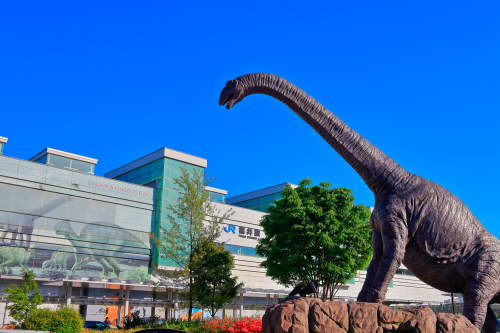
This museum has a fossil information center that is the basis for international dinosaur study, transmitting and receiving study data from throughout the world. There is also a Field Museum, which offers on-site training for everyone to enjoy. This place is full of the mystery and discovery of dinosaurs.One of the three largest dinosaur museums in the world.
3 Yoshizaki Gobo Temple

Address
Yoshizaki, Awara City
Location
20 minutes by car from Kanazu IC of Hokuriku Expressway.
Access here
Contact Info
Awara City Tourism and Commerce Division 0776-73-8029
Outline
The 8th generation chief priest of the Hongan-ji temple, Rennyo Shonin, who is said to be the father of the Shinshu sect revival, escaped from Kyoto after being persecuted by the Hieizan sect and arrived at Yoshizaki. He opened a house for monks, which became his propagation base in Hokuriku later on, in this scenic stronghold land surrounded on three sides by Kitakata Lake. He made great achievements and left important tenets of Buddhism during his stay in Yoshizaki.
4 Genkuro Fujino Memorial Hall

Address
Funatsu, Awara City
Location
Take a Keifuku bus from JR Awara Onsen Station or Echizen line Awarayu-cho station to Tajinbo and get off at Funatsu stop.
Open
9:30-16:00
Closed
Every Monday, year-end through New Year holidays (December 29th to January 3rd)
Fees
Free
Notes
Parking available
Access here
Contact Info
Awara City, Commerce, Industry and Tourism section 0776-73-8029
Outline
This memorial hall, originally the house of Genkuro Fujino in Mikuni town, was donated by his family in 1983 to commemorate the establishment of a sister town relationship between Awara town and Shaoxing city, Zhejiang province in China. The building was reconstructed in a new location in 1984, the year of the 100th anniversary of the Awara Onsen discovery, and named Genkuro Fujino Memorial Hall. The hall exhibits documents about the connection between Dr Fujimoto, an anatomical professor at Sendai Medical training school (currently a medical department at Tohoku University) and a Chinese student, later known as Luxan.
5 Takidanji Temple

Address
Takidani, Mikuni Town, Sakai City
Location
25 minute drive from Kanazu IC of Hokuriku Expressway.
Open
8:00-17:00 November ~ end Febuary 8:00~16:30
Closed
Throughout the year
Fees
Fee Required
Notes
Parking Available
Access here
Contact Info
Takidanji Temple 0776-82-0216
Sakai City Tourism section 0776-50-3152
Outline
Built in 1375, it is the oldest temple in Mikuni Town. It includes many national treasures and important cultural properties. "Sansui-teien", a form of landscape garden developed in those days, especially attracts visitors.
6 Maruoka Castle

Address
Kasumimachi, Maruoka Town, Sakai City
Location
Take a Keifuku bus to Honmaruoka and Eiheiji from JR Awaraonsen Station. 10 minute walk from Honmaruoka bus stop. / Take a Keifuku bus to Honmaruoka from JR Fukui station. Get off at Maruoka-jo bus stop. The castle is nearby. / 5 minute drive from Maruoka IC of Hokuriku Expressway.
Open
8:30-17:00
Closed
Open throughout the year
Fees
Fee Required
Access here
Contact Info
Sakai City Tourism section 0776-50-3152
Outline
Maruoka Castle boasts Japan's oldest castle tower and is also known as "Kasumiga-jo"(Mist Castle). In 1576, at the command of Oda Nobunaga, Shibata Katsuie had his nephew Katsutoyo build this castle for protection against riots. Four-periods after, it was used as a home castle by Tokugawa feudal lords, Honda and Arima, until the end of Edo Period.
7 Senko-no-ie

Address
Kamitakeda, Maruoka Town, Sakai City
Location
Take a Keifuku bus from JR Awaraonsen Station to Honmaruoka. Change to the Keifuku bus to Takeda. 5 minute walk from Takeda bus stop. / 25 minute drive from Maruoka IC of Hokuriku Expressway.
Open
9:00-17:00
Closed
Wednesday (It may be closed in winter during heavy snow falls)
Fees
Fee Required
Access here
Contact Info
Senko-no-ie 0776-67-2111
Sakai City Tourism section 0776-50-3152
Outline
Built in the early Edo period, this residence is noted for being the oldest private house existing in Fukui Prefecture. Its building structure, with a front of semi-gabled roofs, a backside of hipped roofs thatched with grass, walls covered with cedar bark, and white paper doors, shows the clean and neat beauty of the house.It is designated as a nationally important cultural property.
8 Yokokan Garden

Address
Hoei, Fukui City
Location
10 minute walk from JR Fukui Station. / 15 minute drive from Fukui IC of Hokuriku Expressway.
Open
9:00-19:00 (From November 6th to the end of February: Open from 9:00 to 17:00)
Closed
December 28th-January 4th
Fees
Fee Required
Notes
Parking Available
Access here
Contact Info
Yokokan Garden 0776-21-0489
Outline
Yokokan Garden used to be a mansion of the Matsudaira family, lords of Fukui Domain. The garden is located 400 meters north of the Fukui Castle (now Fukui Castle Ruins). The graceful shoin-style building and the magnificent garden are great examples of Edo Period garden architecture.
The Yokokan Garden was highly praised in the Journal of Japanese Gardening, an American specialty publication, for its marvelous construction, the affinity between the building and the water, the beauty of its irrigation, and the view of the pond from inside the building. It was ranked seventh in the Journal’s “2007 Japanese Garden Ranking”.
9 Echizen Great Buddha

Address
Katase Town, Katsuyama City
Location
40 minutes by car from Fukui Kita or Maruoka IC of Hokuriku Expressway.
Open
8:00-17:00
Fees
Fee Required
Notes
Day Tour: Fee Required
Access here
Contact Info
Echizen Daibutsu Daishizan Seidai-ji Temple 0779-87-3300
Outline
This statue of the principal image of great Buddha was modeled from the seated statue of Buddha in the Dafodong of the Ryomon temple suburb of Luoyang city, Henan Province in China, the area from which Buddhism came to Japan. This great Buddha is 17m tall, which is taller than the famous one in Nara, and also has a 23m background halo decoration, a 3m foundation and a 2m lotus shaped pedestal. It is 28m tall in total, weighs 200 tons, and is made of copper. 1281 stone and metal statues are enshrined in the right, left and back walls of the great Buddha, and statues of Luhan and Bodhisattva are placed on both sides.
10 Heisen-ji Hakusan Shrine

Address
Heisen-ji Town, Katsuyama City
Location
Take a Keifuku bus to Oyadani via Heisen-ji from Echizen line Katsuyama station and get off at the Heisen-ji Hakusan Shrine stop. / 50 minutes by car from Fukui Kita or Maruoka IC of Hokuriku Expressway.
Period
Throughout the year
Fees
Free (Partial Fee Required)
Access here
Contact Info
Katsuyama Industrial Commerce and Tourism Division 0779-88-1111
Heisen-ji Hakusan Shrine 0779-88-1591
Outline
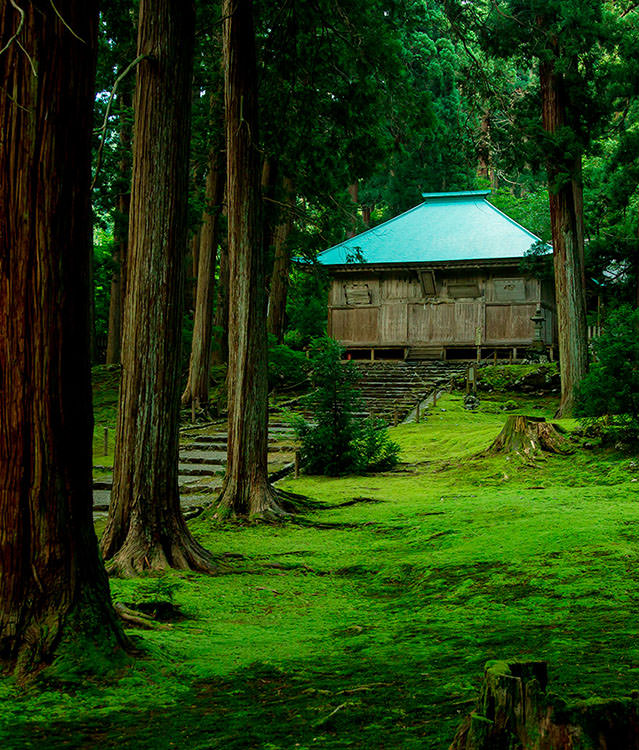
From ancient times to the latter part of the medieval period, this place was influential as the basis of Hakusan beliefs. After the legal order to separate Shinto and Buddhist identity in Meiji period, this place became a shrine instead of a temple. The precincts of this shrine are magnificent, filled with hundreds of old Japanese cedar trees covered by green moss.
11 Ono City Tour
The Ono castle town was established when a retainer of Nobunaga Oda (1534–82), Japanese military commander, built Ono Castle in the Kameyama area. The castle is enclosed with old samurai residences. Also, Ono city has some quaint streets,, such as Shichiken Street where the morning market, Shichiken Asaichi, is held, and Teramachi Street, where many temples are located along the stone paved streets.
Echizen Ono Shichiken Asaichi Market

Address
Ono Shichiken Dori Street
Location
5 minute walk from JR Echizen Ono station. / 40 minutes by car from Fukui IC of Hokuriku Expressway.
Season
March 21(Friday) - December 31(Tuesday)
Open
7:00-11:00
Closed
Closed when it snows.
Access here
Contact Info
Ono City, Tourism Promotion section 0779-66-1111
Outline
These markets with a 300-year-old history are found in Shichiken Dori Street of Ono, where the city streets are laid out in a grid system. These open-air markets offer many fresh vegetables and produce, which are grown and brought to market by wives of the local farmers and displayed on straw mats. The market is just like a kitchen for local people and attracts many local housewives buying ingredients for dinner. It is also a fun community meeting place.
Teramachi Dori Street

Address
Nishiki Town, Ono City
Location
10 minute walk from JR Echizen Ono station. / 40 minutes by car from Fukui IC of Hokuriku Expressway.Expressway.
Access here
Contact Info
Ono City, Tourism Promotion section 0779-66-1111
Outline
Ono City was built by Nagachika Kanamori, a follower of Nobunaga Oda at the beginning of the Tensho Period (1573-1592), as the castle town of Kameyama. Often called ‘Hokuriku’s small Kyoto’, this city with a grid street system has tidy rows of buildings. The streets running both east to west and north to south are named using a number system. A street at the edge of the east side of town called Teramachi Dori street is known for being very secluded with many pretty temples around.
Echizen Ono Castle

Address
Shiromachi, Ono City
Location
25 minute walk from JR Echizen Ono station. / 40 minutes by car from Fukui IC of Hokuriku Expressway.
Season
Year-round facility
Open
9:00-17:00(9:00-16:00 in October and November)
Closed
Closed from December to March
Fees
Fee Required
Access here
Contact Info
Ono City, Tourism Promotion section 0779-66-1111
Echizen Ono Castle 0779-66-0234
Outline
This castle was built in four years by Nagachika Kanamori who was given two thirds of the land in the Ono area by Nobunaga Oda in 1575. There are the two "donjons" or towers. The larger tower has two levels in a three story building and the smaller tower has two levels in a two story building. These towers are also surrounded by two protective walls and by inside and outside moats to protect the castle effectively. The stone walls, built by a special method piling the stone sideways with the big stones pushed behind, are classed as one of the most precious historic places. The present Ono castle was rebuilt in 1968 and exhibits articles left from the successive lords inside.
12 Hokyoji Temple

Address
Hokyoji, Ono City
Location
About a 20 minute drive from the JR Echizen Ono Station. / About a 60 minute drive from Fukui IC of Hokuriku Expressway.
Access here
Contact Info
Hokyoji Temple 0779-65-8833
Ono City, Tourism Promotion section 0779-66-1111
Outline
Hokyoji Temple is located upstream on the Seiryu River, about 10 km to the southwest of Ono City’s central district. Jakuen, the Chinese high priest of the Sung dynasty, built this Soto Zen training temple in 1278. Jakuen came to Japan to study under Dogen, who founded Eiheiji temple, the head temple of the Soto sect of Zen Buddhism. Hokyoji Temple has many prefectural designated cultural properties, such as the portrait of Dogen.
13 Fue Museum

Address
Asahi, Ono City
Location
5 minute walk from JR Kuzuryuko Station / 70 minute drive from Fukui IC of Hokuriku Expressway / 30 minute drive from Shiratori JCT of Tokai-Hokuriku Expressway (via Aburazaka-toge on Chubujukan road).
Open
9:00-16:00
Closed
Mondays・Days after public holidays, December ~ end March
Period
April-November
Fees
Fee Required
Access here
Contact Info
Fue Museum 0779-78-2041
Ono City, Tourism Promotion section 0779-66-1111
Outline
Izumi Village Rekishi no Sato (History Park) is composed of three main facilities, Aoba no Fue Museum (Flute Museum), Anauma Minzoku Museum (Folklore Museum) and Kyodoshiryo Museum (Local Information Resource Center). Aoba no Fue Museum has a replica of an old fife with a story about Minamoto Yoshihira, a warrior in the Heian Period, as well as other instruments such as an ancient clay flute from the Jomon Era.
14 Ichijodani Asakura Clan Ruins

Address
Kidonouchi-cho, Fukui City
Location
Take a Keifuku bus to Joukyoji from JR Fukui Station. Get off at Bukeyashiku bus stop. The ruin is nearby. / 15 minute walk from Ichijodani Station on the JR Etsumi-North Line. / 10 minute drive from Fukui IC of Hokuriku Expressway.
Open
9:00-17:00
Free
Partially Required
Notes
Parking available
Access here
Contact Info
Fukui City, Tourism Development section 0776-20-5346
Outline
The Ichijodani Asakura Clan Ruins are the ruins of the castle town of five warring lords of the Asakura Family who ruled Echizen for 103 years. The grand castle town was founded 530 years ago in 1471 and developed a graceful culture, with the peak population exceeding 10,000. However, when the Asakura Family was defeated by Oda Nobunaga in 1573, the town was burned and its long history came to an end. In 1967, excavation and research started in earnest, uncovering the shape of the whole town, including a house belonging to the lord, samurai residences, temples, houses of merchants, houses of craft workers and streets. In 1991, four gardens in the ruin were designated as "National Special Places of Scenic Beauty".
15 Old Uryu Family Residence

Address
Mizuochi, Sabae City
Location
2 minute walk from Fukui Railway Shinmei Station. / 10 minute drive from Sabae IC of Hokuriku Expressway.
Access here
Contact Info
Sabae City education board 0778-53-2257
Outline
Built in the Genroku era of the Edo period, this residence is the oldest private house existing in Fukui Prefecture. Featuring beam structure using "Matabashira" (forked pillar), the lighted fireplace in the middle of the living room floor when the residence is open reminds visitors of the lifestyle of people in those days.
16 Fukui Botanical Garden Plantpia Asahi

Address
Asahi, Echizen Town
Location
About a 20 minute drive from Sabae IC of Hokuriku Expressway to the Echizen Coastline.
Open
9:00-17:00
Closed
Every Tuesday (Note: The museum is closed on Wednesday when Tuesday is a national holiday) and during the year-end and New Year holidays.
Fees
Fee Required
Access here
Contact Info
Plantpia Asahi, Fukui Botanical Garden Plantpia Asahi, Echizen Town 0778-34-1120
Outline
Plantpia Asahi is the largest botanical garden on the Japan Sea coast. This garden takes advantage of the natural land features and has a botanical museum in the site. The gardens are categorized by the type of plants and include a flowering cherry garden, an acorn garden, an herb garden, and a rock garden. Over 3,000 kinds of plants are grown in a total of 35 sections. This botanical garden attracts both children and adults for recreation.
17 Tsurugi Shrine

Address
Oda, Echizen Town
Location
Take a Fukutetsu bus to Echizen Kaigan via Oda From JR Takefu station and get off at the Myojin Mae stop. / 30 minutes by car from Takefu or Sabae IC of Hokuriku Expressway.
Fees
Treasure House Visit: Fee Required
Access here
Contact Info
Tsurugi Shrine 0778-36-0404
Echizen Town, Tourism Promotion section 0778-34-8705
Outline
This shrine with an 1800-year-old history is known by the bustle of worshippers at New Year’s time. The ancestor of Nobunaga Oda, a famous samurai warrior, was an oracle of this shrine and it is believed that his name, Oda, was derived from this area. The main sanctuary is designated as an important cultural property of Fukui prefecture, and the shrine bell is classed as a national treasure.
18 Echizen Crab Museum

Address
Kuriya, Echizen Town
Location
Take a Fukui Railway bus to Kareizaki from JR Takefu Station. Get off at Active House Echizen bus stop. The museum is nearby. / 40 minute drive from Takefu or Sabae IC of Hokuriku Expressway.
Open
9:00-17:00
Closed
Every Tuesday (The museum is closed on Wednesday when Tuesday is a national holiday. )
Fees
Fee Required
Access here
Contact Info
Echizen Crab Museum 0778-37-2626
Outline
Entering a dome set in a landscape in the shape of a crab, you can find a display that enables you to learn everything about Echizen crabs, an "Experiencing" zone, and a "Study" zone where you can study the biology and ecology of fish and shellfish. Structures such as the three-layer vaulted diorama that features life 300m under the sea, a 3D theater, and a huge robot Echizen crab, promise you an interesting visit. You can also enjoy a tasty crab meal at the museum restaurant.
19 Kitamae Shipping Baron's Mansion

Address
Kono, Minami Echizen Town
Location
Take a Fukui Railway bus to Echizen Coast via Kono from JR Takefu Station. Get off at Konomura-yakubamae bus stop. / 20 minute drive from Takefu IC or 30 minute drive from Tsuruga IC of Hokuriku Expressway.
Open
9:00-16:00
Closed
Wednesday, year-end and New Year holidays, and four days before and three days after the 1st Sunday in August
Fees
Fee Required
Access here
Contact Info
South Echizen Town, Industrial Promotion section 0778-47-8002
Outline
"Kitamae-bune" (cargo ships) used to flourish for transport and trade between Osaka and Ezo (now Hokkaido). Among the owners of such ships was Ukonke, whose residence is now open to the public as a Kitamae-bune history museum. The delicate works that are particular to Kamigata (Osaka and Kyoto) culture can be found everywhere, reminding visitors of its prosperity in those days. Its garden extends all around the mountainside, and you can enjoy the glorious view of Tsuruga Bay and Wakasa Bay from the western-style house and observation deck.
20 Kehi Shrine

Address
Akebono Town, Tsuruga City
Location
Take a community bus called "Hagi Go" (clockwise) from Tsuruga station and get off at Kehi Jingu Mae stop. / 7 minutes by car from Tsuruga Interchange of Hokuriku Expressway.
Open
9:00-17:00
Closed
Open throughout the year
Fees
Free
Notes
Parking and Toilet available
Access here
Contact Info
Kehi Shrine Office 0770-22-0794
Tsuruga City, City Planning and Tourism section 0770-22-8122
Outline
It is believed that this head of tutelary shrines in Hokuriku was built in 702. Locals familiar with the shrine refer to it as "Kei-san". The 10.9m tall great shrine gateway (designated as an important cultural property) is one of the three greatest wooden shrine gateways in Japan, ranked with Kasuga shrine and Itsukushima shrine. The glorious and stately precinct, which is classed as the best in the Echizen area, is popular with the locals as a quiet walking spot. There is a statue of Matsuo Basho, one of the greatest haiku poets, who visited and composed some haiku poems at this shrine.
21 Minato Tsuruga Yama Kaikan Hall

Address
Aioi Town, Tsuruga City
Location
Take a community bus called "Hagi Go" (clockwise) from JR Tusruga station and get off at Yama Kaikan stop / 7 minutes by car from Tsuruga IC of Hokuriku Expressway.
Open
10:00-17:00
Closed
Every Monday, the next day of national holidays, year-end through New Year holidays, 1st of September to 5th of September
Fees
Fee Required
Notes
Parking Available
Access here
Contact Info
Minato Tsuruga Yama Kaikan 0770-21-5570
Tsuruga City, City Planning and Tourism section 0770-22-8122
Outline
This hall exhibits parade floats, which are used for the Tsuruga Matsuri festival. There are show rooms and halls where the dynamic float parades are shown by video or slides on the first floor and permanent exhibition rooms and galleries on the second floor.
22 Saifuku-ji Temple

Address
Hara, Tsuruga City
Location
Take a community bus called "Hagi Go" (counterclockwise) from JR Tsuruga station and get off at Saifuku-ji stop. / 15 minutes by car from Tsuruga IC of Hokuriku Expressway.
Closed
Open throughout the year
Access here
Contact Info
Tsuruga City, City Planning and Tourism section 0770-22-8122
Outline
This Jodo-shu Chinzei sect temple was established by Ryochu Shonin approximately 630 years ago. This temple near the mountains in the western part of the town center offers a great view throughout the four seasons. Especially the autumn scene, created by the colors of leaves is breathtaking. This most sophisticated Jodo-shu temple in Hokuriku was built in the Edo period and designated as a national place of scenic beauty. There are also many more important cultural properties owned by this temple.
23 kumagawa Juku Area

Address
Kumagawa, Wakasa Town
Location
Take a JR bus from JR Kaminaka Station to Omi-imazu. 3 minute walk from Wakasakumagawa bus stop. / 50 minute drive from Tsuruga IC of Hokuriku Expressway. / 30 minute drive from Obama-nishi IC of Maizuru-Wakasa Expressway.
Notes
Parking Available
Access here
Contact Info
Wakasa Town, Commerce, Industry and Tourism section 0770-45-9111
Outline
Having flourished as a town providing lodging for travelers between Kyoto and Obama, Kumagawa-juku has largely developed since the Tensho period (1573-1592). A magistrate's office, a guard station, and a storehouse are a reminder of its prosperity at that time, along with the old-style irrigation canal running along the atmospheric street. Kumagawa-juku has been designated as a preservation area for important traditional constructions and as a select area with historical national roads, and it is among Japan's 100 best water areas.
24 Obama National Treasure Tour
Obama city flourished as a port connecting Japan to other continents and used to have strong ties to Kyoto and Nara. Therefore those ancient capitals’ cultural influences still remain in Obama and some people call it as "Another Nara by the Sea." The city has many buildings and statues of Buddha designated as cultural properties and important cultural assets.
myotsu-ji Temple

Address
Monzen, Obama City
Location
10 minutes by car from JR Higashi Obama station. / 60 minutes by car from Tsuruga IC of Hokuriku Expressway. / 40 minutes by car from Obama Nishi IC of Maizuru Wakasa Expressway.
Season
Year-round facility
Open
9:00-17:00
Fees
Fee Required
Notes
Parking Available
Access here
Contact Info
Obama City, Tourism Exchange section 0770-53-1111
Outline
This temple consists of a main building and a stately pagoda and is illuminated by sunlight falling through the surrounding Japanese cedar trees. 7.5 km away from the station, it is nestled deep in the mountains, where deer can be heard calling in the upper reaches of the Matsunaga River. The temple contains four statues of Buddha from the Fujiwara period that are designated as nationally important cultural properties.
Haga-ji Temple

Address
Haga, Obama City
Location
15 minutes by car from JR Obama station. / 65 minutes by car from Tsuruga IC of Hokuriku Expressway. / 35 minutes by car from Obama Nishi IC of Maizuru Wakasa Expressway.
Open
9:00-17:00
Fees
Fee Required
Notes
Parking Available
Access here
Contact Info
Haga-ji Temple 0770-52-4502
Obama City, Tourism Exchange section 0770-53-1111
Outline
There are many statues of Buddha in this temple. It is said that they were brought here from Kyoto to be protected during the Onin wars. One of them, the wooden statue of the Goddess Kannon Bodhisattva (146.4cm tall, made at the beginning of the Heian period, an important cultural property), is believed to have been modeled on the Gansho empress, who was particularly beautiful.
Mantoku-ji Temple

Address
Kanaya, Obama City
Location
10 minutes by car from JR Higashi Obama station. / 60 minutes by car from Tsuruga IC of Hokuriku Expressway. / 30 minutes by car from Obama Nishi IC of Maizuru Wakasa Expressway.
Season
Year-round facility
Open
9:00-17:00
Fees
Fee Required
Notes
Parking Available
Access here
Contact Info
Obama City, Tourism Exchange section 0770-53-1111
Outline
In autumn the cinnabar colour of Japanese maple trees contrasted with the "Karesansui" (dry Japanese garden style) garden is very soothing for many visitors. The beautiful azaleas are the main attraction in the spring. This temple is full of the beauty of nature that people can enjoy during all four seasons. There is also the principal image of Buddha, the wooden statue of Amitabha Tathagata, and the statue of Bodhisattva, which are worth seeing.