

Echizen Oroshi Soba Noodle

Echizen Oroshi Soba Noodle

Note

Harvest period: October and November

Contact Info

Fukui Noodles Trade Association for Environmental Hygiene 0776-21-3142


Outline

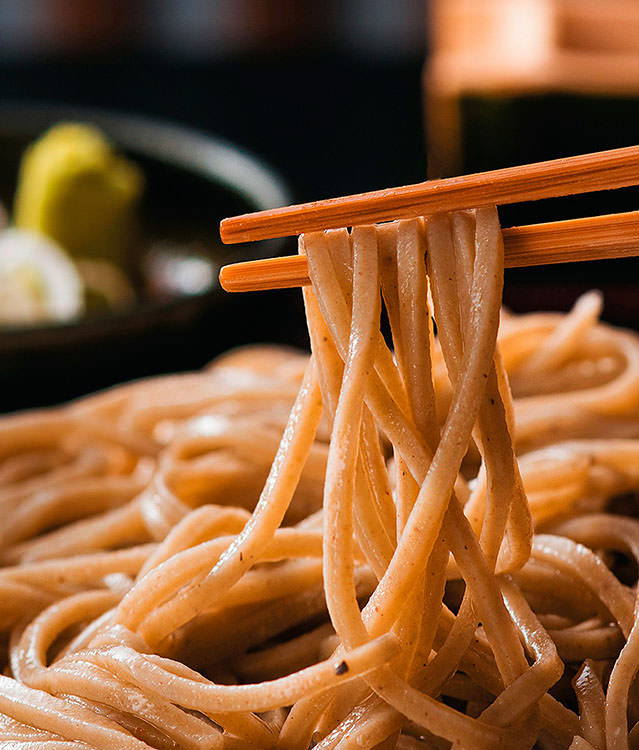
This dish is made from a unique soup, into which is first put grated daikon radish (daikon oroshi), (unlike most dishes, which get served soup and daikon oroshi separately) and firm dark brown soba noodles. The combination of the sweet taste of delicious fragrant soba noodles and the sharpness of grated daikon radish make this meal exquisite. The name ‘Echizen Oroshi Soba’ is believed to come from the Showa emperor who called it ‘That Echizen Soba’ after he visited the town of Takefu in this region and tasted the dish.

Echizen Gani (Crab)

Gani

Note

Fishing period: November to March

Contact Info

Fukui Fishermen's Cooperative Association Sales Division  0776-24-1203


Outline

It is often said that this is the king of winter food. The male crab is called ‘Zuwai’ and female is called ‘Seiko’, and they inhabit the coast of the Sea of Japan. Fishermen catch them using a dragnet and take them back fresh without freezing. These crab are sold at auction fish markets and shipped to Fukui, Kanazawa and even to the Kyoto area.

Wakasa Fugu (Blowfish)

Wakasa Fugu (Blowfish)

Note

Fishing period: November to February

Contact Info

Fukui Fishermen's Cooperative Association Sales Division  0776-24-1203


Outline

At a fish farm in the bay of Wakasa where the tidal flows are good, blowfish are raised in conditions closest to their natural environment. The fish is now one of the winter delicacies in Wakasa.

Grilled Mackerel Sushi

Grilled Mackerel Sushi

Contact Info

Fukui Prefectural Products Association  0776-41-3357


Outline

Grilled Mackerel Sushi is made from grilled fresh fatty mackerels. Once it is grilled, it has neither any excess fat nor fishy taste. They are very tasty, do not leave an aftertaste, and create a delicate flavor with sushi rice.

Habutae Rice Cake

Habutae Rice Cake

Contact Info

Fukui Prefectural Products Association  0776-41-3357


Outline

The Echizen Fukui area flourished because of the silk textile industry. In particular, the satiny textile, called Habutae, was favored as a high-quality textile. A Habutae Rice Cake represents the elegant texture of Habutae and has a very silky texture and a delicate sweetness.

Heshiko

Heshiko

Contact Info

Fukui Prefectural Products Association  0776-41-3357


Outline

Heshiko is preserved fish with soybean paste and is Fukui’s essential nonperishable food during the winter season. Heshiko can be made from many kinds of fish, but mackerel is the most popular ingredient since it is the specialty of the Wakasa area. Other than mackerels, Heshiko can be made from sardines, herrings, and globefish. It is said that Heshiko was originally made in the mid-Edo Period. To make Heshiko, fresh fish is washed, salted, and pickled in rice-bran paste for a year.

Sauce Katsu-Don

Sauce Katsu-Don

Contact Info

Fukui Prefectural Tourism Federation  0776-23-3677


Outline

Typical Japanese Katsu-Don (pork cutlet rice bowl) is made from a deep-fried cutlet bounded together with egg. In Fukui, however, the most popular Katsu-Don is the one with a deep fried cutlet flavored with sauce. A piping hot fried cutlet is quickly dipped with Worcester sauce-based secret seasoning and put on a seasoned rice bowl.

Wakasa Garei (Flatfish)

Wakasa Garei (Flatfish)

Note

Fishing period: September to June

Contact Info

Fukui Fishermen's Cooperative Association Sales Division  0776-24-1203


Outline

The correct name for the fish commonly known as ‘Wakasa Garei’ is ‘Yanagimushi Garei’. This fish is considered one of the treasures among small types of flatfish and is incredibly tasty as a dried product. The clear fish meat is delicious, making it easily understandable why this fish is given to the imperial court every year.

Fukui Rice

Fukui Rice

Note

Harvest period: August to October

Contact Info

Fukui Economic Agricultural Cooperative Association Rice and Wheat Division  0776-27-8257


Outline

The rice called ‘Koshihikari’ which is harvested in the beginning of September was first cultivated by the Fukui agricultural experiment station in 1956 after more than ten years of great effort. Koshihikari, which was created in Fukui prefecture but is now not only grown in Fukui but throughout Japan, is the most popular and regarded as one of most delicious kinds of rice.

Fukui Ume (Plums)

Fukui Ume (Plums)

Note

Harvest period: June and July

Contact Info

Fukui Economic Agricultural Cooperative Association Horticultural Speciality Division  0776-27-8258


Contact Info

One of the main selling points of a Fukui plum is its hearty fruit with a small seed, the best kind of plum to process into ‘Umeboshi’ (pickled plums) or ‘Umeshu’ (plum liquor). The taste is wonderful, as it is grown in a land with gentle sunshine and a sea breeze from the Sea of Japan.

Hana Rakkyo

Hana Rakkyo

Contact Info

Fureai Park Sanrihama  0776-82-3339
Sakai City Tourism section  0776-50-3152


Outline

The rakkyo, or shallot, is famous for its three-year growing period before it gets harvested from the dune area of Sanrihama beach facing the Sea of Japan. The main selling point of this small shallot is its firmness with fine fibre and a fresh crisp taste. The Hana Rakkyo is processed by cutting the top and roots and pickling. It can be bought nationwide in Japan.

Tesuki Oboro Konbu (hand-sliced tangle seaweed)

Tesuki Oboro Konbu

Contact Info

Tsuruga City, City Planning and Tourism section  0770-22-8122


Outline

Tsuruga is one of the few home sliced tangle producers in Japan. This fine silk-like seaweed is produced after being kept damp and softened by vinegar.Today, 85% of the Japanese hand-sliced tangle is produced here.

Amaebi Shrimp

Amaebi

Note

Fishing period: September to June

Contact Info

Fukui Fishermen's Cooperative Association Sales Division  0776-24-1203


Outline

It is said that these clear reddish shrimp will melt in your mouth with a sweet sensation when served raw, as sashimi. Like Echizen Crabs, the Amaebi Shrimp is one of the Japanese people’s favourite winter fruits from the sea. These shrimp are taken from offshore and are then taken directly to the fish market, keeping their freshness and flavour. They are delicious with a hint of sweetness when eaten as sashimi accompanied with soy sauce and wasabi horseradish.

Wakasa Gyu(Beef)

wakasagyu

Contact Info

Wakasa Beef Distribution Promotion Council  0776-54-0205


Outline

The Japanese Tanba family of cattle, which is known for its gentle nature and great quality, has been kept in the Wakasa region since ancient times and was also famous for pulling oxcarts in the Heian Period. The cattle is now recognised by the exclusive, and very tender and marbled meat with a great taste.

Koshi no Ruby (Tomato)

KoshinoRuby

Note

Harvest period: June to November

Contact Info

Fukui Economic Agricultural Cooperative Association Horticultural Speciality Division  0776-54-6463


Outline

This shiny and bright red coloured tomato, which you can imagine from its name, was created by biotechnology, combining large tomatoes and miniature tomatoes. Koshi no Ruby is a medium sized tomato with a full sweetness and a moderate sourness that makes you feel as if you are eating a piece of fruit. It contains 1.5 times more vitamin C than a large tomato and 7 to 8 brix of sugar content, which is 2 to 3 brix more than a large tomato. This nutritious and tasty tomato is now attracting much attention.

Fukui Suika (Watermelon)

Suika

Note

Harvest period: June to August

Contact Info

Fukui Economic Agricultural Cooperative Association Horticultural Speciality Division  0776-54-6463


Outline

With its perfect weather conditions during spring and summer, rich soil, and pure water, Fukui is the most suitable place to grow watermelons. This sweet and juicy watermelon is shipped all over Japan.

Eiheiji Sesame Tofu

sesami

Contact Info

Fukui Prefectural Products Association  0776-41-3357


Outline

Sesame Tofu is a protein-rich food and is a vital source of nutrients for Buddhist monks. It is widely used in their daily vegetarian diet. Eiheiji Sesame Tofu is carefully and slowly made with sesame and kudzu starch. Its soft and silky texture together with the sesame flavor is very delicate.

Satoimo (Aroid)

Satoimo

Note

Harvest period: October and November

Contact Info

Teraru Echizen Agricultural Cooperative Association
0779-65-1250
Fukui Economic Agricultural Cooperative Association Horticultural Speciality Division  0776-54-6463


Outline

This vegetable has been grown mainly in Ono city and Katsuyama city within the Okuetsu region, which has been famous for great quality water since the Edo period. The satoimo, which harvested and shipped from this region, is known by the peculiar sweet taste and the firm body that does not melt away when it is boiled.

Echizen Kantake Mushroom

Kantake

Contact Info

Fukui Ikeda Agricultural Cooperative Association (Processing plant)  0778-44-6505


Outline

The original mushroom brand from Fukui prefecture, selected and cultivated from the tissue culture of the tasty natural Kantake mushroom, can be eaten whole, even its stems.

Fukui Shiitake Mushroom

Siitake

Contact Info

Fukui Forestry Cooperative Association  0776-38-0345


Outline

Logs from the forests of Fukui prefecture (which has many good quality deciduous trees) are used to grow the Fukui Shitake Mushroom. It is widely produced in Fukui prefecture. This rich and tasty natural food is recommended.

Hotaruika (Firefly Squid)

Hotaruika

Note

Fishing period: March to May

Contact Info

Fukui Fishermen's Cooperative Association Sales Division
0776-24-1203


Outline

The main season to enjoy the Hotaruika is between March and June in their breeding period. Fishermen with dragnets catch them when these squid gather in the centre of the bay of Wakasa. A general way of eating these squid is to dress with a vinegar and miso (soy bean paste) mixture after dipping them in the boiling water.

Mushroom

Mushroom

Contact Info

Oi Mushroom Producers' Cooperative  0770-78-1606


Outline

Mushrooms are one of the local products in the Wakasa region. The whole root attached mushrooms are on sale and are popular for a wide range of cooking, from homemade meals to exclusive cuisine.

Pearl Mushroom

PearlMushroom

Contact Info

Miyama Mushroom Growers’ Association  0776-90-3631


Outline

This new kind of pearl white mushroom sets itself apart from normal mushrooms. It is a soft and delicate mushroom that would match any dish.

Shoryu Maitake Mushroom

Shoryu Maitake Mushroom

Note

Sold throughout the year

Contact Info

Shoryu Company Ltd  0779-78-2255


Outline

This comes from the rare ‘Kuro Maitake Mushroom’ (black Maitake mushroom), which grows wild in the natural forest deep in the mountains. Shoryu Maitake Mushrooms are grown in a favourable natural environment. Their natural taste, fragrance and texture are excellent.

Wakasa Kaki Oyster

Kaki

Contact Info

Fukui Prefecture Fishery Cooperation Union Federation
0776-24-1203


Outline

Once they become stuck to a reef, oysters remain there by nature, making them very suitable for farming. In Fukui Prefecture, the calm waves of the bay of Obama are ideal for raising oysters. Oysters grown in the bitter cold weather conditions of the Sea of Japan offer a high level of taste and fragrance.

Wakasa Guji (Japanese Tilefish)

Guji

Contact Info

Sales Division, Fukui Prefectural Fisheries Cooperative Joint Association
0776-24-1203


Outline

Wakasa guji, or Japanese tilefish, are a specialty of the Wakasa peninsula and one of the finest ingredients in Japanese cooking. Salted Wakasa Guji used to be sent to Kyoto via the Mackerel-Road along with salted mackerels and Wakasa flatfish, as they are important ingredients for Kyoto cuisine.
Wakasa Guji live in the rough Wakasa peninsula, which is the converging point of warm and cold currents, and are fed by high-quality foods. The taste is light but has a sophisticated savor.

Ayu

ayu

Contact Info

Sales Division, Fukui Prefectural Fisheries Cooperative Joint Association
0776-24-1203


Outline

Ayu is a kind of sweet fish, and the size of an adult fish is about 15-25cm. Recently the number of wild Ayu is very small and therefore a large number of baby fish is released into the river every year. The embargo for Ayu fishing is removed in mid June. During the season, the Kuzuryu River, Asuwa River, and Hino River are crowded with anglers.

Kodai Sasazuke

kodai

Contact Info

Obama Sasazuke Association  0770-52-2820


Outline

Kodai Sasazuke is a preserved renko sea bream, salted and pickled with rice vinegar in a wooden barrel. It is a specialty product of the Obama area.