Fukui's Seasonal Food Calendar: Fall (September–November)
Fukui Prefecture is abundant with a rich variety of seasonal foods. Here are some foods that are in season during the fall (September through November).
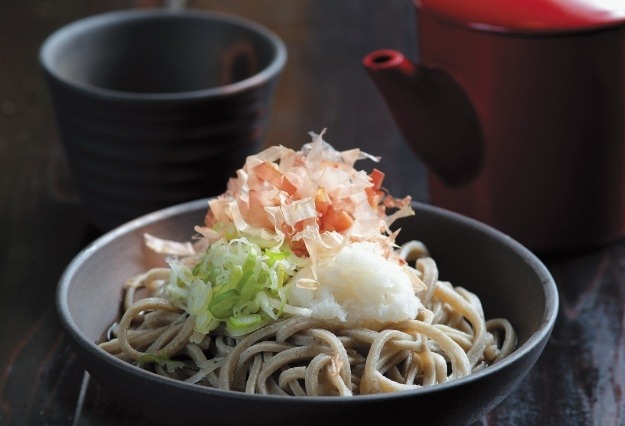
Echizen Oroshi Soba
Traditional Echizen soba, cultivated in an ideal environment.
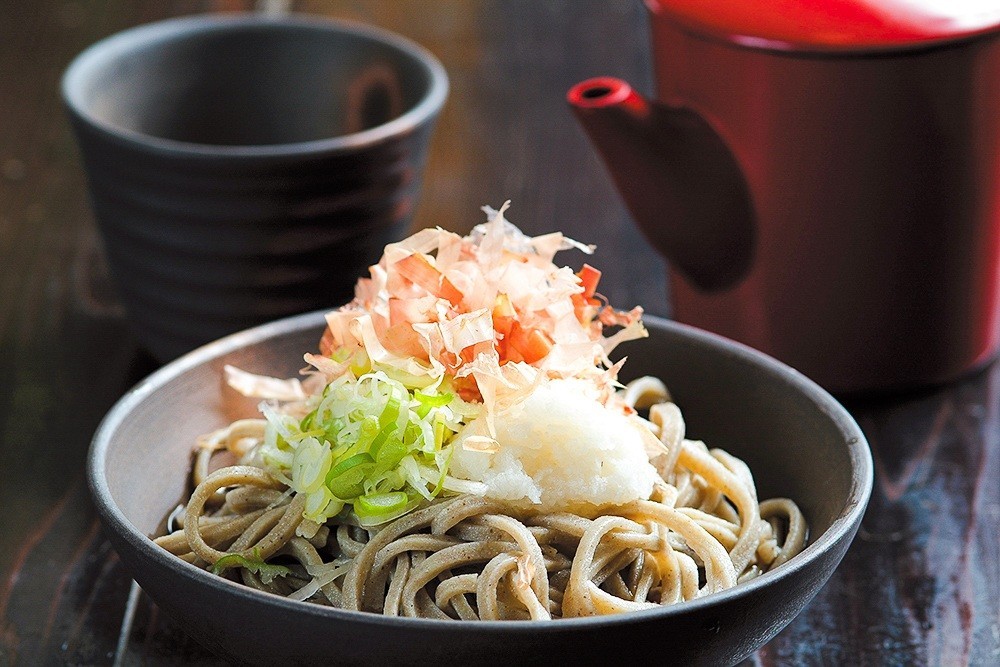
Echizen Oroshi Soba noodles are typically served with green onions and bonito flakes. The flavorful buckwheat noodles pair perfectly with the slightly spicy grated daikon radish.
Although it is a simple dish consisting of soba topped with grated daikon radish, its flavor is rich and complex, and it has recently been gaining attention as a longevity food.
In this article, we’ll explore the history behind the deliciousness of Echizen Oroshi Soba.
It is said that the history of soba in Fukui began around 1473, when Asakura Takakage built a castle in Ichijodani. After numerous battles, soba became highly valued as a food source during sieges. This was because soba could be harvested in a short period of about 75 days from sowing. However, even back then, soba-gaki (soba flour cakes) and soba-dango (soba dumplings) seem to have been the main dishes.
“Soba-kiri” first appeared in Fukui in 1601. When Lord Honda Tomimasa, who had become the lord of Fuchu (present-day Echizen City), took office accompanied by the soba master Kaneko Gonzaemon, the way soba was eaten changed. It is said that, in addition to noodle-style soba, the practice of serving it with grated daikon radish began at that time.
Soba noodles with grated daikon radish. This combination was embraced by the common people, and subsequently, under the guidance and cooperation of Fukui Prefecture and the Fukui Prefecture Gen-Soba Promotion Council, soba cultivation and consumption expanded, leading to the popularity of oroshi soba we see today.
Furthermore, it was after 1947 that Fukui’s oroshi soba spread nationwide as “Echizen Oroshi Soba.” In October 1947, when Emperor Showa visited Fukui, he enjoyed two bowls of oroshi soba. After returning to the Imperial Palace, he fondly recalled the oroshi soba he had eaten, remarking, “The soba from Echizen was truly delicious”—a comment that gave rise to the name.
Furthermore, the deliciousness of “Echizen Oroshi Soba” is deeply connected to the high quality of the whole buckwheat grains and the milling techniques used. This is because the quality of buckwheat is closely related to the latitude of the cultivation area.
It is said that buckwheat flour with superior taste and flavor is often found in the region between the 36th and 38th parallel north. Fukui is located on the 36th parallel north, which means it meets the conditions necessary for producing high-quality whole buckwheat.
Then there is the milling method. All milling companies in Fukui Prefecture use traditional stone milling. This careful, time-consuming process ensures that not only the taste but also the unique aroma of buckwheat is preserved.
A Hearty Splash
Dousing noodles with broth is a convenient way to enjoy soba at home or when dining with a large group. You can adjust the flavor to your liking with condiments. Many people from outside the prefecture who see this way of eating soba for the first time are surprised by its hearty presentation. However, once they taste it, they’re convinced by its deliciousness, and almost all of them become fans.
Currently, there are roughly three ways to enjoy oroshi soba in Fukui Prefecture.
○ Adding dashi and grated daikon separately
○ Add grated daikon to the dashi
○ Add the juice from the grated daikon to the broth
While the flavors may seem slightly different in each case, “Echizen Oroshi Soba,” made with whole buckwheat from Fukui Prefecture, offers a taste that everyone can enjoy.
Commitment to Safety
Since the 1960s, the Fukui Prefecture Gen-Soba Promotion Council has been promoting buckwheat cultivation as part of a crop rotation policy. The council provides guidance on proper cultivation and storage methods. These efforts continue today, and both the area under cultivation and the harvest volume are increasing year by year. Currently, to expand consumption and distribution of locally produced buckwheat in Fukui Prefecture and to promote the “Echizen Oroshi Soba” brand, the prefecture has established the “Certification System for Restaurants Using Delicious Fukui Prefecture Buckwheat” (currently 70 participating establishments).
In Fukui, “Oroshi Soba” is typically served cold, generously topped with grated daikon radish and doused with dashi broth. We invite you to savor “Echizen Oroshi Soba,” which has been selected as one of the “100 Selected Local Dishes” of Fukui.
- Echizen Karami Daikon
- Daikon radish is an essential ingredient for Echizen Oroshi Soba Noodles. In Fukui Prefecture, the spicy Echizen Karami Daikon is particularly popular. The reason for this is that its spiciness enhances the taste and flavor of the soba. Karami Daikon is smaller and rounder than regular daikon, and is characterized by being completely buried in the soil at harvest time.
The harvest season runs from late October through December—which coincides perfectly with the new soba season. By the way, grating it with the skin still on seems to bring out even more of its spiciness, so why not give it a try? 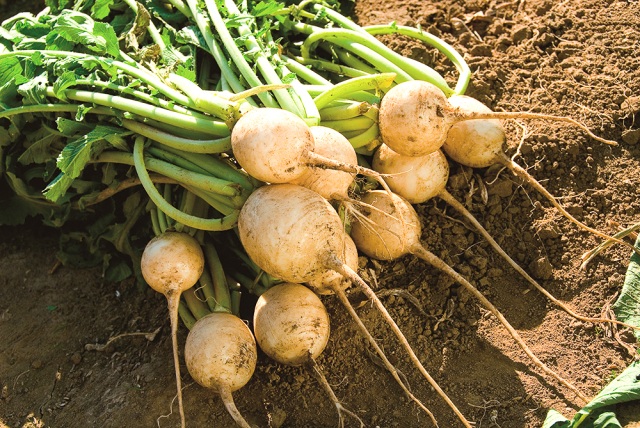
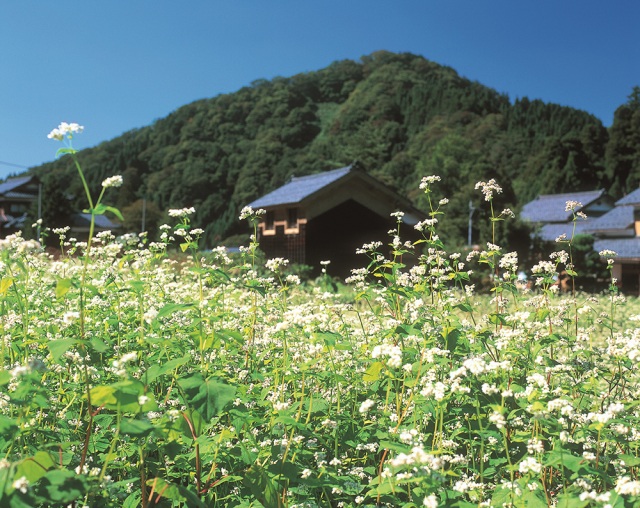
- Buckwheat Fields · Buckwheat Flowers
- Seeds are sown around mid August, and from September through late October, the fields are blanketed with a stunning display of delicate white buckwheat flowers. Afterward, the stems turn red, and harvesting begins around early November, when the white flowers have turned into black seeds. That’s when the flavorful new buckwheat makes its debut.
- Stone-ground buckwheat noodles
- The unhulled buckwheat grown in Fukui Prefecture is characterized by its small grains and thin husks. After harvest, the unhulled buckwheat is stored in a warehouse with strictly controlled temperature and humidity. The buckwheat grains are separated into the hull and the kernel, and the kernel is sent for stone milling. Since the outer husk is ground along with the kernel during this process, the resulting buckwheat flour takes on a dark color.
Traditional, low-speed stone milling not only grinds the flour but also kneads it simultaneously. As a result, the particles remain round during milling, and the unique flavor of buckwheat is preserved. In contrast, high-speed roller milling crushes the grains mechanically, which degrades the quality of the whole buckwheat. 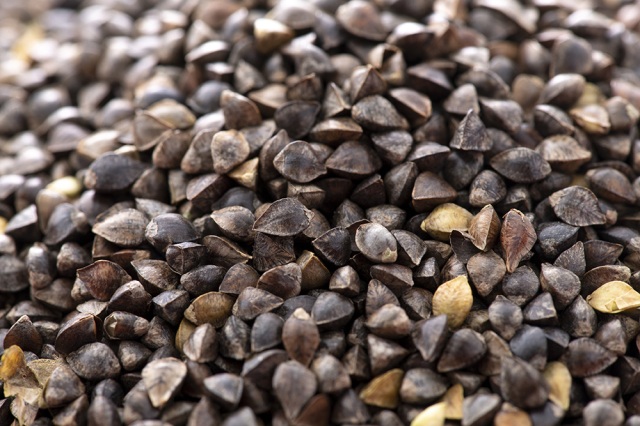
Kamisho Satoimo
"Taro"—a source of pride, nurtured by the climate of Echizen.
Unique Texture and Flavor
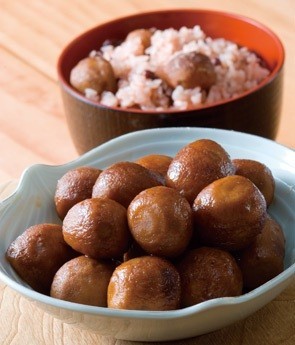
Simmered Taro
Taro grown here is a product of the unique local environment of Oku-Echizen—the pure, abundant water flowing from Mt. Hakusan, the basin climate with its extreme temperature differences between day and night, and the alluvial fan terrain. With minimal slime and a distinctive texture, many people say they’ll never forget it once they’ve tasted it. Another characteristic is its firm flesh, which holds its shape well even when simmered.
The quintessential traditional local dish is, without a doubt, “Nikkorogashi.” Though it is a simple dish simmered in a sweet-and-salty sauce of soy sauce and mirin, its robust flavor and firm texture make it hard to stop at just one—you’ll find yourself reaching for another piece before you know it. It is a home-style dish beloved by people of all ages and genders.
In Fukui, a region with deep Buddhist roots, taro is served during the “Ho-onko” ceremony. It’s also used in festival and celebratory dishes, such as “taro red rice” (satoimo sekihan), which is cooked with soy sauce-simmered taro, and “imo botamochi,” made by mixing taro into glutinous rice. Furthermore, as an ingredient in miso soup and oden (a winter dish of various ingredients stewed in soy-flavored dashi), it’s an indispensable part of daily life for locals.
Although small in size, taro has a firm texture that holds its shape well when simmered. This allows you to fully savor its rich umami flavor. In addition to “Nikkorogashi,” there’s “Noppei-jiru,” a stew simmered with plenty of vegetables and Atsu-age Fried Tofu, and “Dengaku,” where the taro is grilled over a brazier or stove and dipped in miso. You can enjoy a wide variety of taro dishes.
Fukui Rice (Koshihikari)
Rice farming that makes the most of nature's bounty.
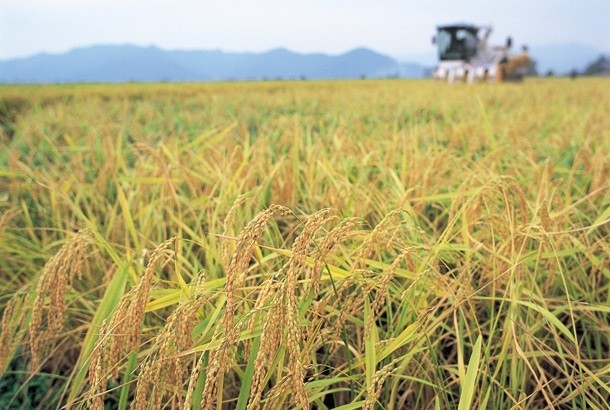
It is the result of a blessed natural environment and climate, as well as the hard work and ingenuity of the people.
The history of Koshihikari began in 1944 in Fukui Prefecture. At the time, although it was a hybrid variety, it was prone to lodging and had other flaws, such as susceptibility to rice blast, so it did not attract much attention.
However, over the next decade or so, following numerous cultivation innovations and improvements, it was named Koshihikari in 1956. Since then, it has spread throughout the country.
Since 1979, Koshihikari has boasted the largest cultivated area in the country, and currently accounts for approximately 37% of the total cultivated area. Furthermore, when combined with its “children”—such as “Hitomebore” and “Hinohikari”—its “grandchildren,” such as “Hana-Echizen,” and its “great-grandchildren,” such as “Kirara 397,” a staggering 85% of all rice varieties are descendants of “Koshihikari.” Koshihikari was born in Fukui. Fukui Prefecture possesses the expertise, technology, and passion to understand Koshihikari and produce exceptional rice. Furthermore, the prefecture’s unique climate, soil, and water are indispensable to its delicious flavor.
Koshihikari, born in Fukui Prefecture and cultivated with the constant goal of achieving the best flavor in the nation, is sweet and lustrous. Its taste, which remains just as delicious even when served cold, is sure to delight both your palate and your heart.
Okuetsu-grown Koshihikari
Harvesting begins around the end of August. In the mountainous Okuetsu region of eastern Fukui, in addition to Koshihikari and Hana-Echizen, sake rice production is also thriving, making it one of Fukui Prefecture’s leading production areas.
When it comes to Koshihikari, it’s synonymous with delicious rice.
In Fukui Prefecture, rice cultivation is focused on achieving the highest quality.
This time, we spoke with an expert about growing rice in the Okuetsu region, blessed with abundant natural beauty.
The Okuetsu region in eastern Fukui Prefecture is blessed with a particularly rich natural environment, featuring the foothills of Mt. Hakusan and rivers such as the Kuzuryu River and Managawa, which store abundant water. While many crops are grown here, rice farming in particular has long been the subject of various innovations and efforts, always aiming to produce delicious rice. Among these, Koshihikari has become a highly popular variety nationwide for its sweetness, stickiness, and rich flavor.
As for these innovations and efforts, the first step is basic soil preparation. Farmers take great care to cultivate excellent soil by deeply tilling the earth, replenishing deficient nutrients (such as phosphorus and silica), and incorporating organic fertilizers to enhance soil fertility. At the same time, they have created regional soil maps. By analyzing the soil, they actively promote the “right crop for the right place” approach, selecting crops and cultivation methods best suited to each specific plot of land.
But that’s not the only reason why rice from Okuetsu tastes so good.
“Above all, it’s thanks to nature’s bounty—the climate, water, and soil of Okuetsu. All these elements combine to create that delicious flavor,” says Mr. Kiyama, one of the producers.
Since the Okuetsu region is mountainous, the daily temperature range—the difference between day and night—is greater than in flatlands. These dramatic temperature fluctuations stimulate the crops, allowing them to ripen fully and develop a rich, deep flavor.
Another blessing of nature is water. The Kuzuryu River flows across Fukui Prefecture, supporting the lives of its residents. Since Okuetsu is located upstream, it has access to fresher, purer water. It’s safe to say that the fresher the water, the greater the positive impact on the rice.
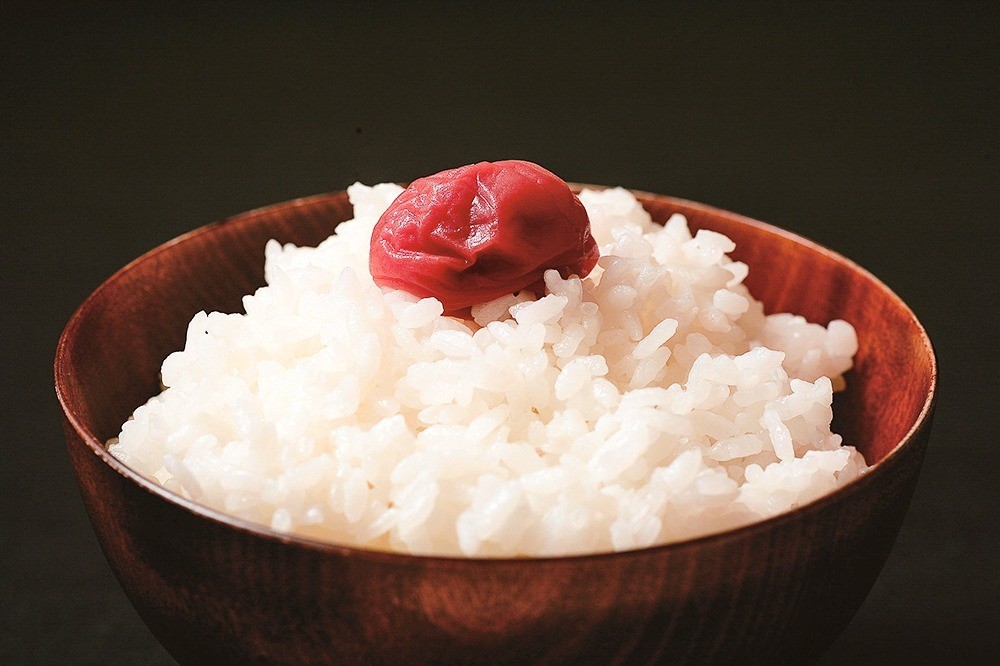
Okuetsu-grown Koshihikari is produced by harnessing these natural blessings and the ingenuity and hard work of the farmers. Not only is it highly regarded both within and outside the prefecture, but it also consistently maintains a score above the benchmark of 80 in taste analysis—a figure indicating exceptional flavor. With its consistent taste and reputation for safety and reliability, this rice is gaining attention nationwide.
Commitment to Safety
After harvest, rice produced in the Okuetsu region undergoes analysis across more than 10 categories—including the whole-grain rate (the percentage of high-quality grains) and taste score (deliciousness)—broken down by region. A taste score of 80 is generally considered the benchmark for deliciousness, and rice from the Okuetsu region consistently maintains scores close to this benchmark.
Echizen Gani Crab
Definitely a must-try for winter in Fukui! A limited-time, exquisite treat
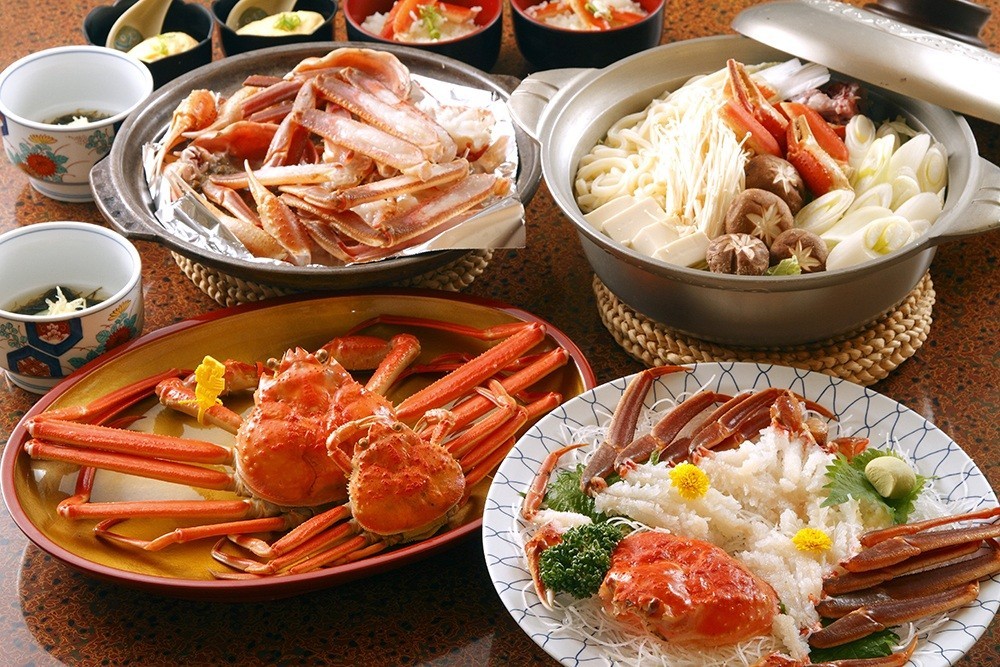
The Sea of Japan in winter. The colder it gets, the richer and more delicious seafood becomes. Among these, the “Echizen Gani Crab”—a specialty of Fukui Prefecture—is known as the king of winter delicacies. It has countless fans across the country, and even gourmet connoisseurs recognize its exceptional flavor.
In this article, we’ll explore the history and reasons behind its deliciousness, as well as introduce “Echizen Gani Crab” dishes created by local chefs. Discover the new charms and flavors of “Echizen Gani Crab,” and be sure to give it a try.
The terraced seabed along the Echizen Coast provides an ideal habitat for crabs.
Its flavor, worthy of the title “King of Flavors,” boasts a deep umami that you’ll never forget once you’ve tasted it.
Behind that umami lies the exceptional environment of the fishing grounds.
A seasonal delicacy. The perfect balance of salt and the precise boiling time are the keys to its flavor.
While the excellent fishing grounds are the foundation of its deliciousness, the perfect balance of salt and the precise boiling time take it to the next level.
There is a local saying: “It takes ten years to learn to judge a crab, but a lifetime to cook it properly.” This means it takes ten years to become a skilled crab connoisseur, and a lifetime to master the art of cooking (boiling) it to perfection. That’s how difficult it is to handle crab. And the artisans who master the boiling process are vital to maintaining the “Echizen Gani Crab’s” status as the king of crabs. Incidentally, there are three types of crab caught along the Echizen Coast. First is the male snow crab, “Echizen Gani Crab”; second is the female crab, “Seiko-gani”; and third is “Mizugani,” which is snow crab immediately after molting. Each has a different fishing season and a unique flavor.
The deliciousness is limitless. The flavors unique to the region are innovative and refreshing.
When it comes to how to eat “Echizen Gani Crab,” boiled crab is the most popular choice, but that’s not all. There are various other ways to enjoy it, such as sashimi, grilled crab, shabu-shabu hot pot, and crab-infused rice. Since the crab itself is so delicious, its flavor remains just as wonderful no matter how it’s prepared. In fact, you could even say the flavor is elevated.
Furthermore, at local restaurants, creative dishes crafted by chefs who know the ingredients inside and out are hugely popular. Every day, chefs are researching and developing wonderful dishes—such as pasta, risotto, and steak—that make the most of the crab’s unique qualities. We hope you’ll visit Fukui to savor not only the classic crab dishes but also these innovative creations.
Echizen Gani Crab (Snow Crab)
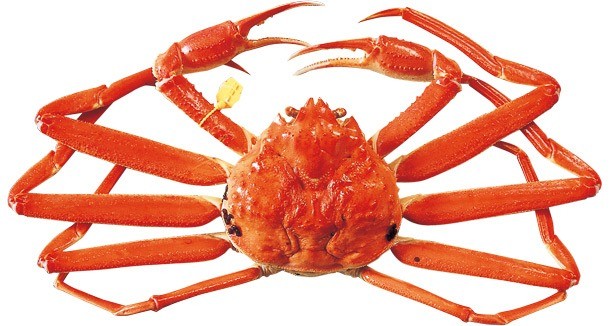
The yellow tag is proof of authenticity!
This tag was first adopted nationwide to make it easy to distinguish Echizen crab from crabs from other regions, and since then, other regions have also begun introducing similar tags. Each tag differs in color and shape, allowing you to identify the crab’s origin at a glance.
Try placing the meat from the legs into the shell—which contains the crab roe—mixing it all together, and savoring the combination... You’re sure to discover a flavor of crab unlike anything you’ve ever tasted before. Many people have fallen in love with this taste and become fans of “Echizen Gani Crab.”
Seiko Crab (Snow Crab)
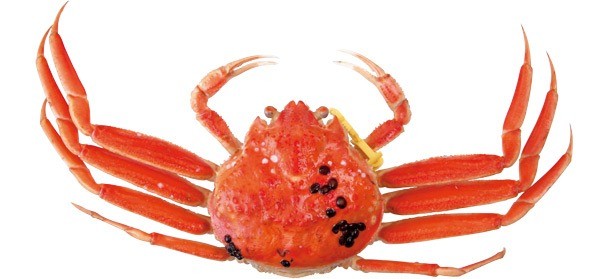
Be sure to try the crab roe! A delicacy available for only two months
Seiko Crab refers to female crabs that inhabit depths of approximately 230–250 meters on the seafloor, with a body length of around 25 cm.
Its most distinctive feature is undoubtedly what’s inside its abdomen. The fertilized eggs, known as “outer roe,” have a delicious, poppy texture. And the deep orange ovaries, known as “inner roe,” are a delicacy often referred to as “red diamonds.”
Incidentally, since Seiko crab begins spawning around January 10 of the following year, the fishing season lasts only until around that time. It’s a rare delicacy that can be enjoyed for just about two months, starting from the opening day of the season on November 6. Not only are they large, but they’re also reasonably priced, so many locals are fond of Seiko crab.
Vibrant orange external roe.
“Seiko no Seige” is a dish made simply by placing shredded Seiko crab, grated daikon radish, and miso in a pot and simmering it until done. Once the pot comes to a boil and the color of the grated daikon begins to change, it’s ready to eat. It’s perfect served over rice or as a snack with sake. Incidentally, “Seige” refers to a hot pot with miso and is a traditional local dish that has been passed down for generations.
- Hot Pot
- In addition to boiled “Echizen Gani Crab” and Seiko crab, the dish is packed with plenty of seafood and vegetables. The broth, infused with the rich flavors of these various ingredients, is perfect for making a rice porridge to finish off the meal.
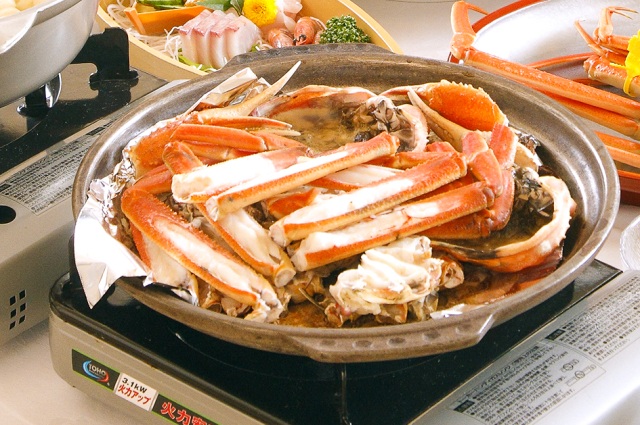
- Boiled
- We adjust the amount of salt and cooking time based on the weather and conditions on the day the crabs are landed. That perfect balance of salt brings out the sweetness of the crab meat.
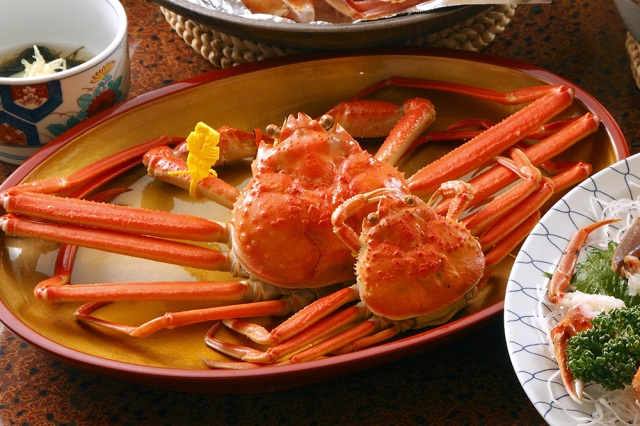
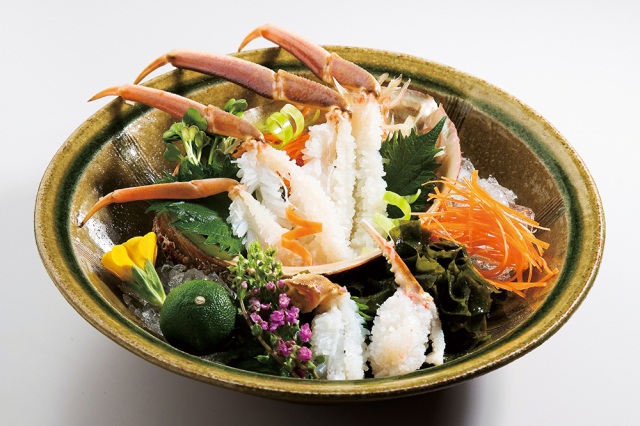
- Sashimi
- When you soak a semi-translucent raw crab in cold water for a few seconds, the crab meat spreads out softly, as if blooming. You can savor its subtle sweetness and the aroma of the sea.
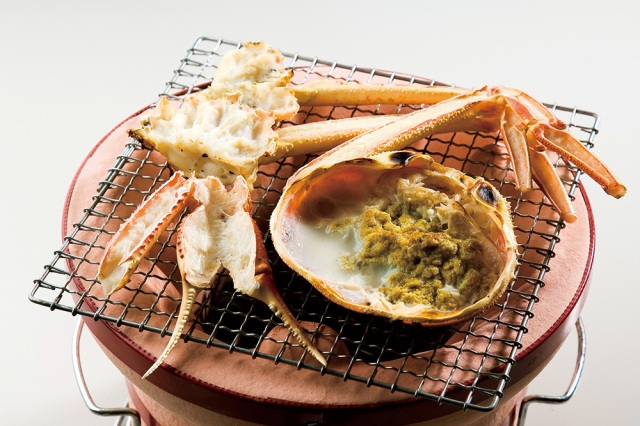
- Grilled
- Just make a slit in the crab legs and grill them. Even though it’s that simple, you can enjoy a flavor that’s different from boiled crab. “Whole-roasted crab”—where a live crab is grilled whole—is also very popular locally.
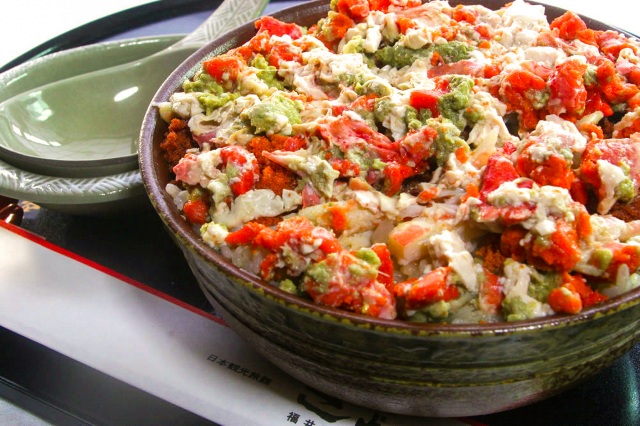
- Rice Bowl
- Top freshly cooked rice with a generous portion of Seiko crab legs, roe, and sperm sac, then pour over a broth made from crab paste—and it’s ready. This is the “Kaiko Don,” an original dish from a long-established ryokan that was beloved by Akutagawa Prize-winning author Takeshi Kaiko, who described it as “the sea’s jewel box.”
Wakasa Fugu Blowfish
Why is the fugu raised in the northernmost region for aquaculture in Japan so delicious?
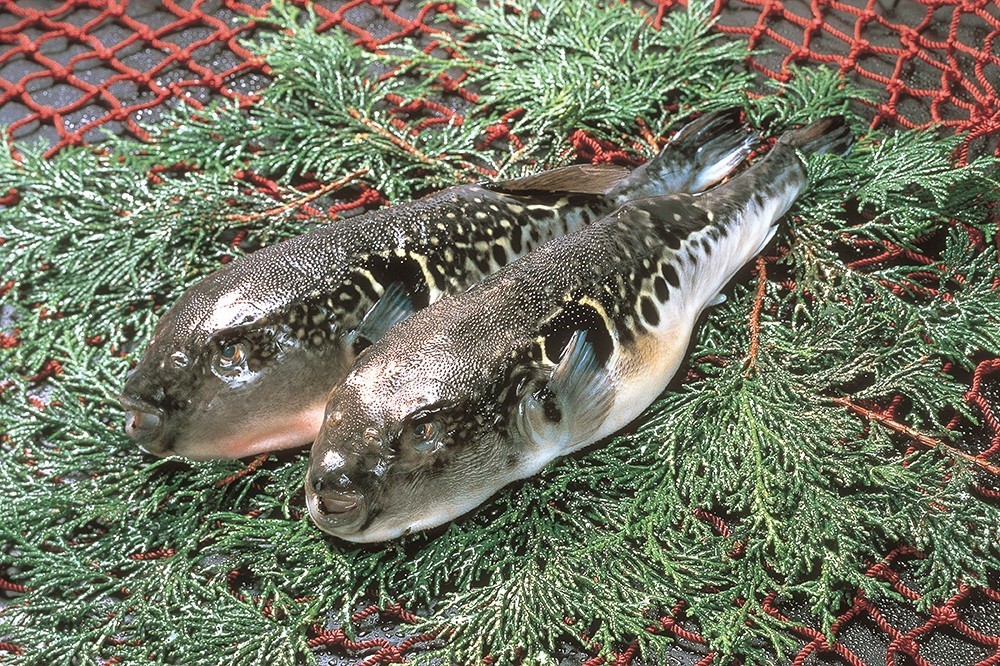
Among the various types of fugu primarily consumed as food, the “torafugu” is considered the “king of blowfish” and is renowned as the most delicious and high-quality variety. Fukui Prefecture is one of Japan’s leading production areas for torafugu, ranking sixth nationwide in production value (according to the 2008 Annual Report on Fisheries and Aquaculture Production Statistics). The main production areas for torafugu in Fukui Prefecture are Tsuruga City, Mihama Town, Wakasa Town, Obama City, and Takahama Town; these locations represent the northernmost limits of fugu aquaculture in Japan. The torafugu, painstakingly raised by producers in this coldest region of Japan, is marketed under the “Wakasa Fugu” brand and shipped not only within the prefecture but also to areas outside it, where it is highly regarded.
The primary reason Wakasa Fugu boasts a flavor that’s a cut or two above that of other prefectures is its exceptional aquaculture environment. From March to May, the region experiences a longer period of low water temperatures compared to other areas due to snowmelt. Raised in these harsh winter conditions—yet in waters with relatively calm waves even during the coldest months—Wakasa Fugu develops firm flesh and accumulates a rich, full-bodied umami flavor.
Mr. Nakai farms Wakasa Fugu in Tsuruga City. His farm is located near Mizushima Island, a destination that attracts many tourists every year. “I release only the finest juvenile fish—which I’ve personally selected—into the net pens. Every day, I monitor the fugu's health and feed them the very best food. Since the farm is in the ocean, I adjust the feeding regimen to suit the natural environment.“ We raise them so that you can enjoy the very best Wakasa Fugu when water temperatures start to drop during the shipping season.”
Wakasa Fugu is a high-end variety of torafugu characterized by its firm, sweet flesh; the season runs from November to March. You can enjoy Wakasa Fugu at local ryokan, guesthouses, and restaurants. During the winter months, many food connoisseurs visit Wakasa in search of this flavor.
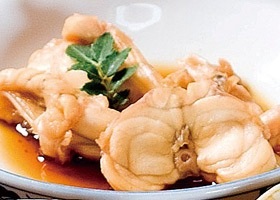
- Simmered Fugu
- While tessa and tecchiri are classic fugu dishes, I was introduced to a fugu dish brimming with creative ideas unique to the region. I’m told it’s particularly popular with women. It’s my top recommendation—a dish where the bones release a delicious broth.
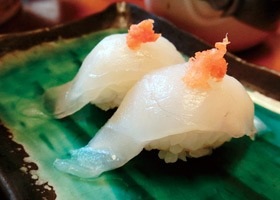
- Wakasa Fugu Nigiri
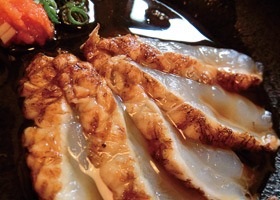
- Wakasa Fugu Tataki
Amaebi Sweet Shrimp
A distinctive aroma and sweetness that fill your mouth. The vibrant vermilion color is a sign of exceptional freshness.
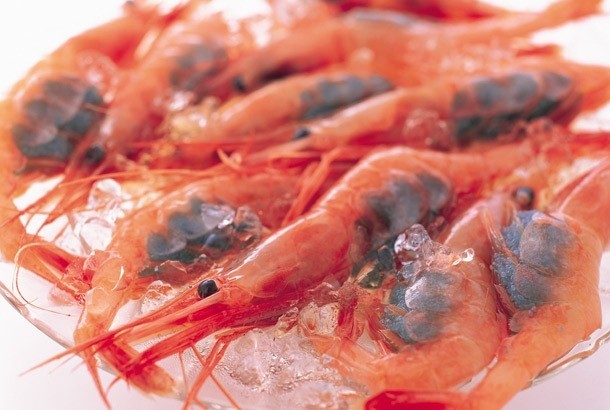
At Mikuni Port, one of the main fishing ports for bottom trawling in Fukui Prefecture, the peak fishing season for “amaebi” runs from September through October and from March through June. Although “amaebi,” with an annual catch of approximately 210 metric tons, is said to be firmer and more delicious in winter, the crab fishing season begins in November. Consequently, the period for “amaebi” fishing is longest from September to October, and operations are concentrated during this time. Like crab, the landed “amaebi” are rigorously sorted based on roe content, size, and quality, and are put up for auction immediately upon arrival at the port. As the boats return to port, wholesalers and fishmongers gather one after another, and the harbor gradually comes alive with activity.
“Amaebi” with blue, grain-like roe on their bellies—known as “roe-bearing”—command the highest prices.
Alongside Echizen Gani Crab and Wakasa Fugu Blowfish, “Amaebi” Sweet Shrimp is a signature delicacy of Fukui Prefecture’s winter season, boasting a lustrous vermilion color that is simply mesmerizing. The moment you put one in your mouth, you’ll sense a faint aroma of the sea, followed by a melt-in-your-mouth texture and a rich sweetness that spreads across your palate. Every aspect—from its flavor to its texture—is truly distinctive. Those caught in the sandy-muddy seabeds of coastal waters at depths of 200 to 500 meters, where the seabed is clean, possess a unique chewy texture and sweetness.
You can judge their freshness by their body color: those with high transparency and heads that aren’t blackish are of the highest quality. It’s also said that letting them rest overnight enhances their sweetness, making them even more delicious than when eaten fresh or immediately after being caught.
Among bottom-trawling fisheries (fishing methods that use nets to drag along the seabed to catch sweet shrimp, crabs, and other bottom-dwelling species), Mikuni Port in Fukui Prefecture has the highest catch volume of “amaebi.” At this time of year, the port is bustling with sweet shrimp fishing activity.
Column
Fall in Fukui
Discover the beautifully unique scenery, activities, foods, and events to enjoy in Fukui in the Fall